
Electric garage doors offer convenience and security, yet many homeowners ask what happens during a power cut. Most systems stop operating by remote control when the mains supply fails, but that does not always mean the door becomes unusable. Many models include a manual release that lets you open and close the door by hand, provided you can access the garage safely. Understanding your door type and safety features helps you prepare for outages.
Key takeaways
- Most electric garage doors will not open or close automatically during a power cut.
- A manual emergency release lets you disengage the motor and operate the door by hand.
- You must ensure the door is balanced, as heavy doors can be difficult to lift.
- Some systems include battery backup, which keeps the opener working for limited cycles.
- If the garage has no side access, fit an external release to regain entry.
- After power returns, re-engage the trolley and reset limits if required.
How electric garage door openers depend on mains power
Most electric garage door openers rely on mains electricity to run the motor, control board, safety sensors, and courtesy light. When the supply fails, the opener cannot drive the door because the motor needs electrical power to turn the drive system, such as a belt, chain, or screw. The wall switch and remote handset also stop working because the receiver and control electronics lose power.
Many systems include a low-voltage transformer inside the opener housing. That component converts mains power into a safer voltage for the logic circuits and photoelectric safety sensors. If the transformer cannot draw power, the opener cannot process commands or confirm that the doorway remains clear. Guidance from DHF (Door & Hardware Federation) also highlights the need for functioning safety devices on powered doors, which depend on a live supply.
Some openers offer battery back-up, which keeps key functions running for a limited number of cycles. Without that feature, a power cut leaves the door operable only through the manual release mechanism, provided the door remains correctly balanced and maintained.
What happens to an electric garage door during a power cut
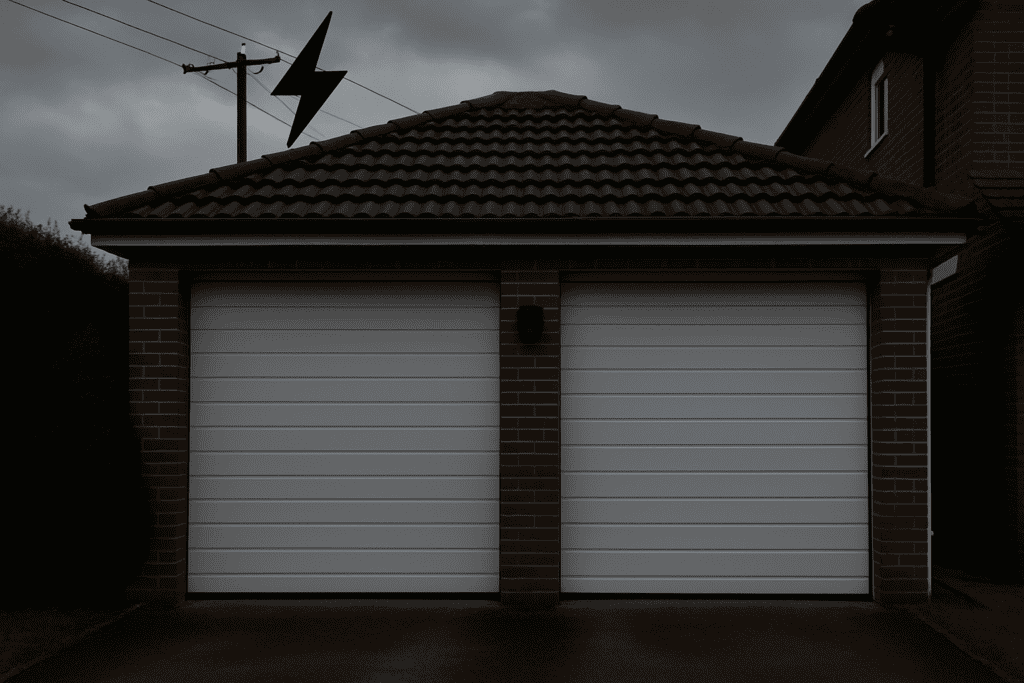
During a power cut, an electric garage door usually stays in its last position. If the door sits closed, the opener cannot lift it until power returns or a manual release is used. When the door stands open, the opener cannot pull it down under power, so the opening may remain unsecured until the door is closed manually.
Most openers include a manual emergency release, often a cord with a handle that disengages the trolley or carriage from the drive mechanism. Once disengaged, the door should move by hand along its tracks. A well-balanced door will feel relatively light; a door that feels heavy or drops quickly may have a spring or cable fault and needs attention from a competent engineer.
Safety behaviour can also change. For example, the door will not respond to remote commands, and any automatic closing features will not operate. Some models use a battery back-up, which can keep the opener working for a limited number of cycles. For guidance on battery back-up and manual release features, consult the manufacturer documentation, such as Hörmann or Chamberlain.
Using the manual release: safe steps to open and secure the door
Most electric garage door openers include a manual release that disconnects the door from the motor drive. This feature lets a person move the door by hand during a power cut. Use the steps below to reduce the risk of injury and to keep the garage secure.
- Check the door position. If the door is closed, keep clear of the opening area before disengaging the opener. If the door is open, support the door if possible, as some doors can drop when released.
- Switch off power if available. Turn off the opener at the isolator or consumer unit to prevent unexpected movement when electricity returns.
- Locate the emergency release. Find the red cord and handle hanging from the trolley or carriage on the opener rail.
- Disengage the drive. Pull the handle down firmly to release the trolley. On some models, the handle also needs a short pull towards the door to latch in the manual position.
- Lift or lower the door by hand. Use the internal handle and lift with steady force. Stop if the door feels unusually heavy, sticks, or moves unevenly, as a spring or cable fault may exist.
- Secure the door. Close the door fully and engage a manual lock if fitted. If no lock exists, use a garage-rated hasp and padlock, or secure the side access door and remove valuables from view.
After power returns, re-engage the opener before using a remote. Many units reconnect when the door moves under manual control until the trolley clicks back into place. For model-specific guidance, consult the manufacturer instructions, such as the manuals provided by Chamberlain or Hörmann. If the door will not balance or feels unsafe to move, arrange a professional inspection before continued use.
Battery backup and alternative access options: what works and what does not
A battery backup can keep some electric garage door openers working during a power cut, but only when the opener includes a compatible battery unit. Many modern systems offer this as an optional add-on or an integrated feature. For example, selected models from Chamberlain and LiftMaster support battery backup that powers the motor and control electronics for a limited number of open-and-close cycles. Capacity varies with door weight, temperature, and battery age, so performance rarely matches normal mains operation.
Battery backup does not solve every access issue. If the door has a mechanical lock engaged, the opener still cannot move the door safely. Some accessories also stop working, such as plug-in smart home hubs or Wi-Fi routers, which can prevent app control even when the opener runs. A battery unit also cannot compensate for a door that binds on worn rollers or misaligned tracks, since higher resistance drains the battery quickly.
When no battery backup is fitted, alternative access depends on physical entry. An external emergency release lock can help when the garage has no other door, while a separate pedestrian door provides the simplest access route.
How to prepare for future outages: maintenance, testing, and security checks
Plan for outages before one occurs. Start with routine door maintenance, since a well-balanced door moves safely by hand when the opener has no power. Arrange periodic servicing of springs, cables, rollers, and hinges, as worn parts can cause the door to drop or jam during manual operation. If a professional inspection is due, use a qualified installer and follow the manufacturer guidance for the specific opener model.
Test the manual release at least twice a year, ideally in daylight. With the door closed, pull the emergency release handle, lift the door smoothly, then re-engage the trolley as instructed in the manual. Confirm that the door stays at waist height without drifting, as poor balance signals a spring issue that needs prompt attention. After re-engagement, run a normal open-and-close cycle once power is available.
Security checks matter during longer cuts. Keep the internal access door to the house locked, and verify that any side door has a British Standard cylinder. When the garage door must remain closed, consider fitting a mechanical lock or a garage defender that does not rely on electricity. For safety and compliance, review the latest guidance from HSE on maintaining equipment in a safe condition.
Frequently Asked Questions
Do electric garage doors open during a power cut?
Electric garage doors do not open using the motor during a power cut. Most models include a manual release cord or lever that disconnects the door from the opener, allowing you to lift and close the door by hand. If the door feels heavy, check for a broken spring and seek professional help.
How does the manual release mechanism work on an electric garage door?
A manual release disconnects the door from the motor so it can move by hand. Pull the emergency cord or handle to disengage the trolley from the drive. Lift and lower the door carefully, keeping a firm grip. Once power returns, re-engage the mechanism by operating the opener or reconnecting the trolley.
Can a garage door opener run on a battery backup during a power cut?
Yes, if the opener includes a compatible battery backup, it can operate during a power cut. The battery supplies short-term power for a limited number of open and close cycles, depending on door weight and usage. If the unit has no battery backup, use the manual release to open the door by hand.
What should you do if the garage door will not disengage from the motor during a power cut?
Check that the door is fully closed and not under tension. Locate the manual release cord and pull it firmly down, then towards the door to disengage the trolley. If it still will not release, do not force it. Inspect for a jammed lock or damaged cable and contact a qualified technician.
Will a power cut damage an electric garage door motor or control board?
A power cut rarely damages a garage door motor or control board. Most systems tolerate loss of mains power and resume normal operation when electricity returns. Damage can occur if a power surge happens as supply restores, or if the door is forced while engaged. A surge protector and correct manual release use reduce risk.